

Tin tức
Fabric ducts manufacturer OEM 2026
08
Th2
Th2
Nội dung chính
Fabric ducts (also called fabric air dispersion systems or textile ducts) are used in HVAC systems to distribute air through a permeable fabric duct instead of traditional metal ductwork.
Here’s a clear, practical overview 👇
1. What are fabric ducts?
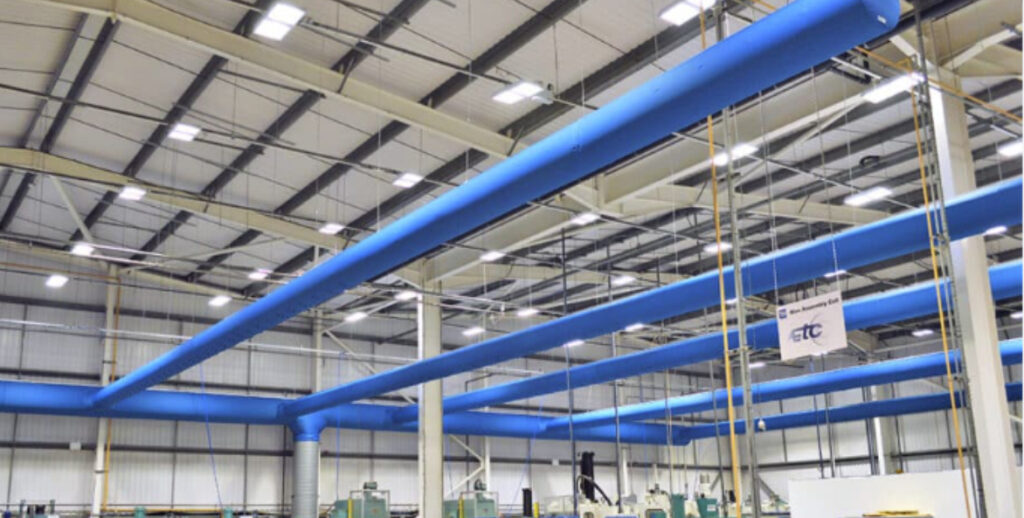
Fabric ducts are lightweight ducts made from engineered textile materials (polyester, coated polyester). Air is supplied through laser-cut holes, micro-perforations, or fabric permeability, creating uniform air distribution.
How they work
- Air enters the fabric duct from an AHU or fan
- Air exits through:
- Perforations (directional airflow)
- Nozzles (long throw)
- Permeable fabric (draft-free diffusion)
- This produces even air distribution with low velocity
- Key advantages
✅ Uniform airflow – eliminates hot/cold spots
✅ No condensation – fabric breathes and equalizes surface temperature
✅ Lightweight – up to 80–90% lighter than metal ducts
✅ Lower noise – fabric absorbs sound
✅ Easy installation & maintenance – washable and removable
✅ Energy efficient – improved air mixing reduces overcooling
Typical applications
🏭 Industrial plants and factories
❄️ Cold storage & refrigerated warehouses
🏟 Sports halls & gyms
🛒 Supermarkets & retail spaces
🍞 Food processing plants (food-grade, antibacterial fabrics)
🧪 Medium-level cleanrooms (ISO 7–8)
2. Fabric ducts are widely used in food
and beverage facilities when they are designed and selected correctly. Below is a food-industry–focused guide (practical, not marketing fluff).
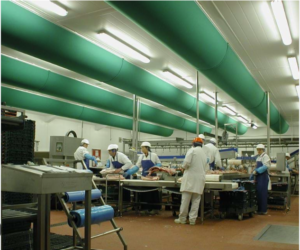
Why fabric ducts work well in food plants
✅ Excellent hygiene – ducts can be removed and machine-washed
✅ No condensation drip – critical above open food lines
✅ Uniform airflow – avoids strong drafts that dry or contaminate products
✅ Low bacteria growth risk – with antimicrobial fabrics
✅ Quiet operation – better working environment
✅ Corrosion-free – unlike metal ducts in humid areas
- Air distribution strategy in food facilities
- Correct airflow design is critical.
- Best practices
- Use micro-perforations or laser-cut holes, not fabric leakage
- Supply air from the side or above operators, not directly onto food
- Maintain positive pressure in clean areas
- Zoning: separate ducts for raw vs cooked areas
- Typical food industry applications
🍞 Bakeries
🥩 Meat & poultry processing
🥛 Dairy plants
🥬 Fresh produce packing
🍫 Chocolate & confectionery
❄️ Cold rooms & chilled processing areas
3. Fabric ducts are very common and very effective in factories
Especially where you need even airflow, low drafts, and fast installation. Here’s a factory-focused breakdown
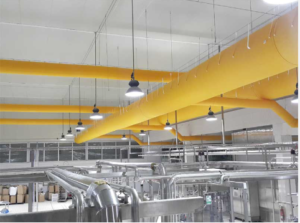
Why factories use fabric ducts
✅ Uniform air distribution over large areas
✅ Improved worker comfort (no cold air blasting)
✅ No condensation dripping (big deal in humid plants)
✅ Lightweight & fast installation (minimal structural load)
✅ Lower noise than metal ducts
✅ Corrosion-free in humid or chemical environments
✅ Easy reconfiguration when production layout changes
Typical factory applications
🏭 Electronics & assembly plants
🏭 Textile & garment factories
🏭 Plastic & rubber plants
🏭 Packaging & printing
🏭 Automotive parts
🏭 Warehouses & logistics centers
❄️ Cold storage & chilled production areas
Choosing the right fabric duct type
1.1 Comfort cooling (people-focused)
- Permeable or micro-perforated fabric
- Very low air velocity at occupied zone
Best for assembly lines, electronics, clean production
1.2. Process cooling
- Non-permeable fabric with laser holes or nozzles
- Directional airflow
- Suitable for hot machines
- Air & pressure
- Not suitable for very high-pressure systems
- At duct outlet: designed via hole size & spacing
- Installation height
- Ideal: 4–12 m
- Can be circular, half-round, or quarter-round
4. Using fabric ducts with an AHU (Air Handling Unit)
is a very common and proven solution—if the interface and design are done correctly. Here’s a clear, AHU-focused explanation.
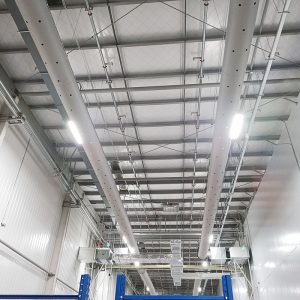
How fabric ducts connect to an AHU
Fabric ducts are installed supply of the AHU, replacing metal supply ducts and diffusers.
Typical configuration:
- AHU → short metal plenum / transition → fabric duct
- Why the metal section?
- Stabilizes airflow
- Reduces turbulence
- Protects fabric from high velocity at the AHU outlet
👉 Never connect fabric duct directly to the fan outlet.
Key AHU design parameters for fabric ducts
1. Static pressure
- Ideal range: 120–250 Pa
- Max (varies by supplier): 300–1000 Pa
- Fabric ducts do not like high-pressure systems
2. Air velocity at connection
- Recommended: ≤ 8.5 m/s
- Use a plenum if AHU outlet velocity is higher
3. Air temperature
- Comfort HVAC: 5–45 °C
- Special fabrics:
- Up to 80–120 °C (coated polyester)
4. Humidity
Works very well in high humidity Eexcellent for avoiding condensation issues
- Fabric duct types used with AHUs
- Comfort cooling (offices, factories, halls)
- Permeable or micro-perforated fabric
- Draft-free diffusion
- Best thermal comfort
- Process cooling / spot cooling
- Non-permeable fabric with laser holes or nozzles
- Directional airflow
- Used in factories, heat-load zones